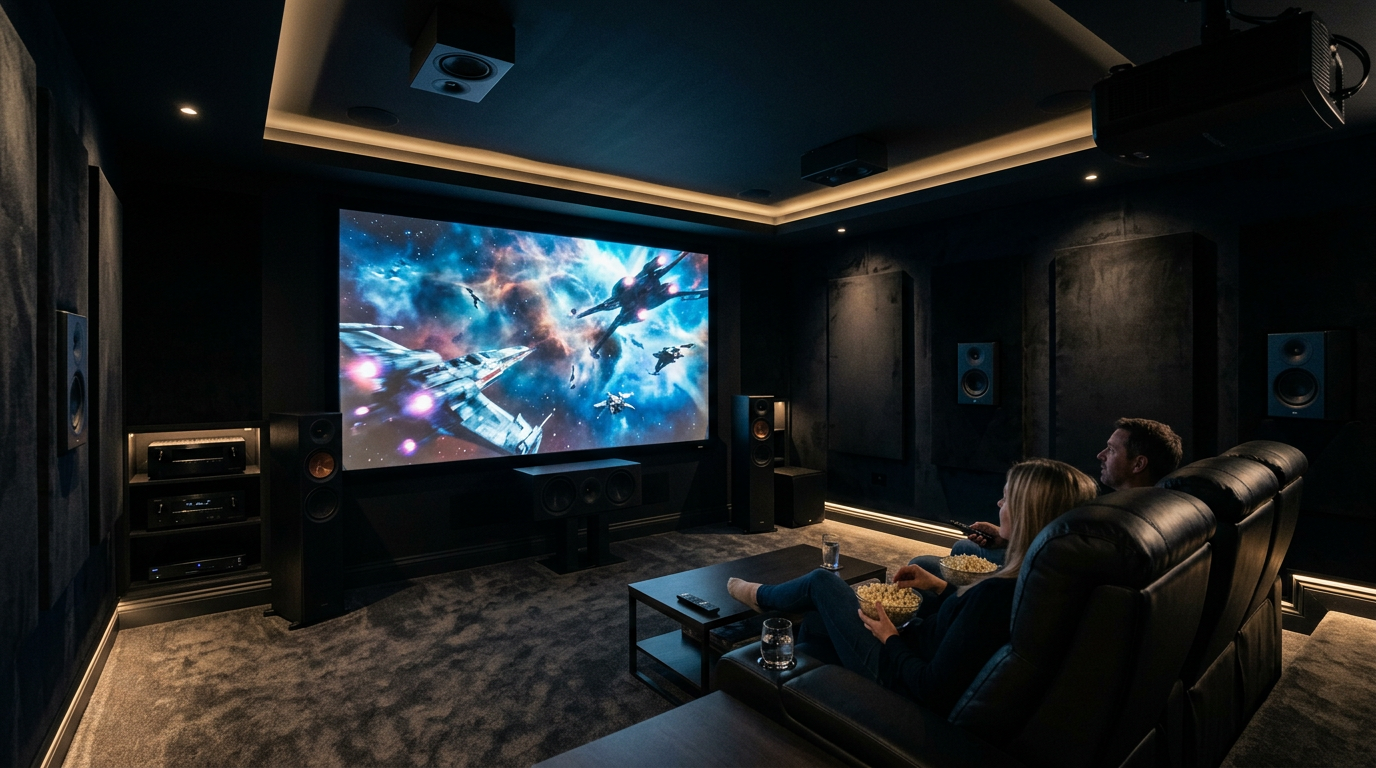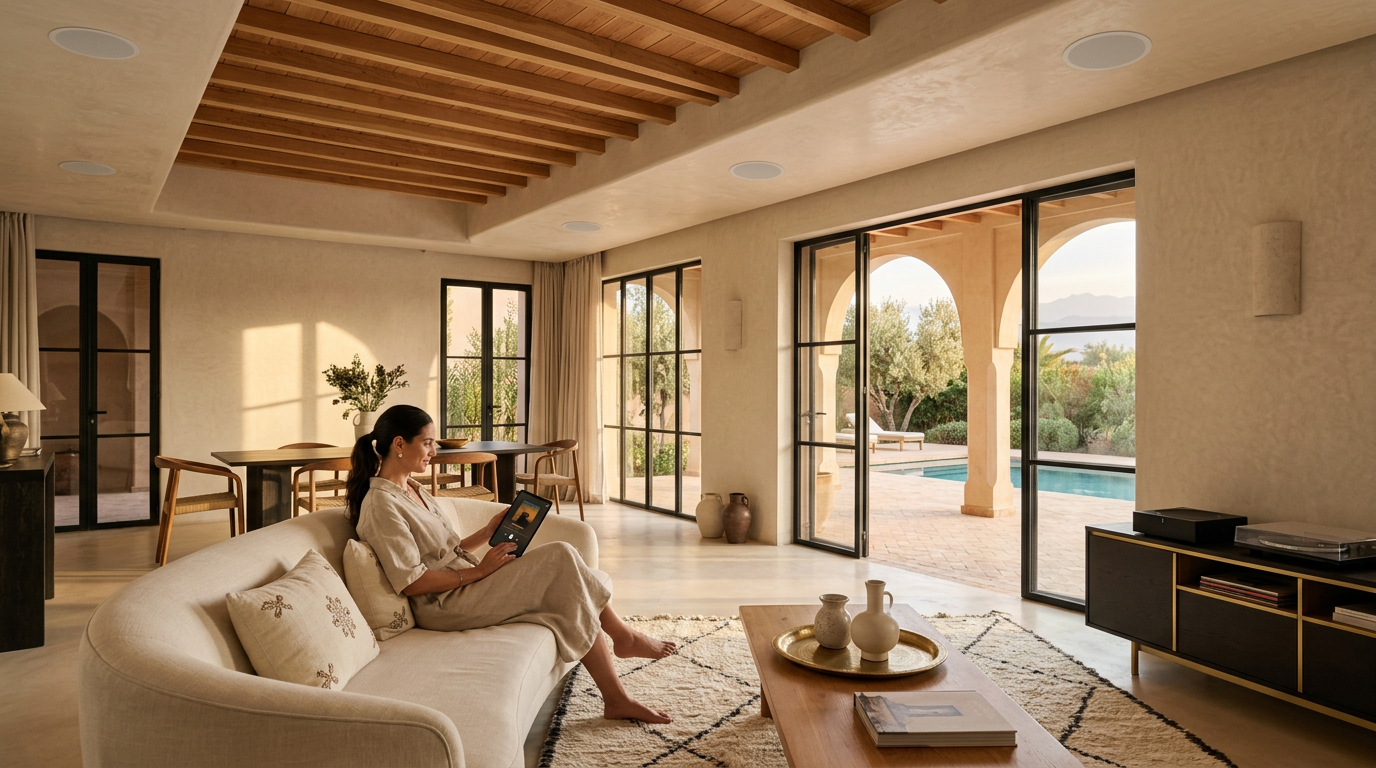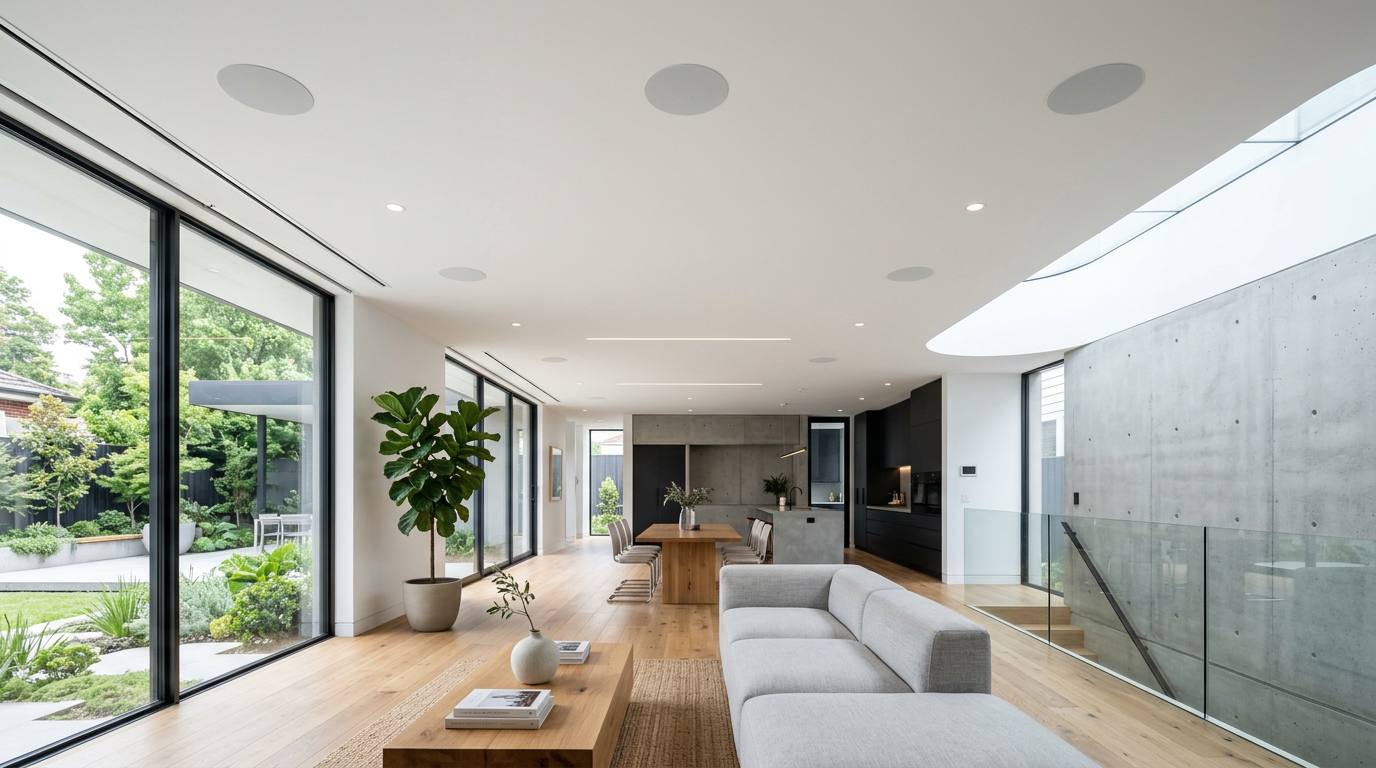
The in-wall speaker is the secret of beautiful homes. No black box on a shelf, no visible cable: the sound seems to come from nowhere. It's the preferred solution for interior designers and demanding homeowners in Morocco. But between IC (ceiling), IW (wall) and INF (invisible) models, 4, 6 or 8 inch sizes, and amplification questions, the choice can be confusing. This guide covers everything you need to know.
IC, IW, INF: understanding in-wall speaker types
IC — In-Ceiling
The speaker is recessed into a circular hole cut in the ceiling (drywall or tile false ceiling). Only the grille remains visible, flush and painted to match the ceiling. This is the most common type for ambient music: living rooms, hallways, kitchens, bathrooms.
Elipson's Architect range includes:
- IC4 (100 mm) — Small spaces, corridors, toilets
- IC6 (165 mm) — Versatile, bedrooms, kitchens, offices (2,390 MAD per pair)
- IC8 (210 mm) — Living rooms, rooms >20 m² (2,990 MAD per pair)
IW — In-Wall
The speaker is recessed into the wall partition, in rectangular format. Sound dispersion is frontal and directional — ideal for home cinema (centre channel, surrounds) or for creating a precise stereo image in a living room.
- IW6 (165 mm) — Home cinema surrounds, offices
- IW8 (200 mm) — Centre channel, main stereo speakers (3,490 MAD per pair)
INF — Infinite (invisible)
Elipson's INF series uses a carbon fibre membrane and is covered with plaster or paint. Once finished, the speaker is literally invisible — no grille, no visual clue. It's the ultimate in architectural integration.
- INF 6 (160 mm, carbon) — Medium-sized rooms, invisible Hi-Fi sound (3,490 MAD)
- INF 8 (200 mm, carbon) — Large spaces, audiophile demand (4,090 MAD)
Smart Living tip: INF speakers are a long-term investment. They're decided at the construction or heavy renovation stage, as they require plastering after installation. The result is spectacular: your guests will wonder where the music is coming from.
What size for which room?
The basic rule is simple: the larger the room, the larger the speaker must be to maintain proper bass without forcing the volume.
| Room surface | Recommended size | Elipson model |
|---|---|---|
| < 10 m² (toilet, dressing) | 4 inches (100 mm) | IC4 |
| 10 – 20 m² (bedroom, office, kitchen) | 6 inches (165 mm) | IC6 or IW6 |
| 20 – 40 m² (living room, master suite) | 8 inches (200 mm) | IC8, IW8 or INF 8 |
| > 40 m² (large living room, open plan) | 8 inches × 2 pairs | 2 × IC8 or 2 × INF 8 |
For a typical Moroccan living room of 30-40 m² with a 3 m ceiling, a pair of Elipson IC8 offers an excellent power/discretion compromise. If you're aiming for total invisibility, the Elipson INF 8 disappear under the plaster.
Amplification: the invisible heart of the system
In-wall speakers are passive (except rare exceptions). They need a connected amplifier to work. It's this amp that brings streaming, multiroom and smartphone control.
Premium option: Sonos Amp
The Sonos Amp (8,399 MAD) is the reference amp for in-wall installations:
- 125W per channel at 8 ohms — comfortable power for all Elipson speakers
- Native Sonos multiroom — group with your existing Era, Arc, Five
- HDMI ARC to connect the TV
- AirPlay 2, Spotify Connect, Amazon Music, Deezer, Qobuz
Budget option: WiiM Amp
The WiiM Amp (2,490 MAD) offers 60W/channel — enough for a pair of IC6 or IC8 in a bedroom or office. AirPlay 2, Chromecast, Bluetooth, Spotify Connect. At one third the price of the Sonos Amp.
Our packs simplify the choice:
- Invisible In-Wall Pack — Sonos Amp + INF speakers for a totally invisible installation
- 3-Zone Multiroom In-Wall Pack — 3 Sonos Amp + 3 pairs of in-wall speakers to cover the whole house
- Invisible Cinema Pack — 5.1 in-wall system with centre channel and IW surrounds
Installation: key steps
1. Pre-wiring (rough-in phase)
This is the most important and least expensive step. Before closing the partitions and false ceiling:
- Run a 2×2.5 mm² speaker cable (or 2×4 mm² for runs >15 m) from the amp location to each speaker point.
- Leave 1 m of slack at each end for easy connection.
- Label each cable (« Living room L », « Living room R », « Bedroom 1 »...).
- Plan an RJ45 Ethernet cable to the amp location (multiroom stability).
Golden rule: Always plan 2-3 extra wiring points. The marginal cost during rough-in is negligible (a few metres of cable), but adding a point after finishing costs thousands of dirhams in chasing and plaster repair.
2. Ceiling cutout
Each Elipson speaker comes with a cardboard cutout template. The procedure:
- Position the template on the ceiling at the desired location, keeping a minimum distance of 60 cm from walls.
- Trace the outline in pencil.
- Drill a pilot hole, then cut with a hole saw of the correct size (diameter on the spec sheet).
- Check for obstacles behind (electrical conduit, metal structure) before cutting.
3. Installation and connection
- Pass the speaker cable through the hole.
- Connect the terminals (respect + / – polarity).
- Insert the speaker into the hole — the integrated mounting claws automatically clamp the drywall.
- Clip the magnetic grille (on Elipson IC/IW models).
4. For INF (invisible) speakers
After mechanical installation, the plasterer applies a thin coat of plaster to the speaker's front membrane. Once dry, they sand and paint to match the ceiling or wall. Result: a smooth surface with no visible grille. Only a technician knows where the speakers are hidden.
Choosing between 6 and 8 inches
The difference isn't just about volume:
- 6 inches (IC6, IW6, INF 6) — More precise frequency response in the mid-highs. Decent bass down to ~60 Hz. Cutout ~18 cm: fits most false ceilings, including closely spaced hangers.
- 8 inches (IC8, IW8, INF 8) — Deeper bass (~45 Hz), superior dynamics. Cutout ~23 cm: requires a false ceiling with at least 12 cm depth and hangers spaced >30 cm.
In summary: if your false ceiling has limited depth (<10 cm) or the room is under 20 m², 6 inches is the rational choice. Beyond that, 8 inches brings superior listening comfort, especially for music.
Acoustic isolation: avoiding sound leakage
An in-wall speaker in a false ceiling also radiates upward — into the plenum, the floor above or the neighbour. Solutions:
- Back-box — Elipson offers optional recess boxes that isolate the back of the speaker. They reduce sound leakage by 10-15 dB and improve bass response by controlling rear air volume.
- Mineral wool — If you don't use a back-box, place a 10 cm thick block of rock wool (Rockwool type) behind the speaker. Don't block vents if they exist.
- Decoupled false ceiling — For upper floors, a false ceiling on anti-vibration hangers (Placo Stilprim type) significantly reduces upward transmission.
Compatibility with Moroccan false ceilings
In Morocco, BA13 drywall false ceilings on metal framing are the standard. Good news: all Elipson IC and INF speakers are compatible with BA13 (12.5 mm thickness). The claw mounting system clamps the drywall without additional screws.
Special cases:
- Wood false ceiling (zellige, tadelakt) — Thickness may vary. Check that the depth available behind the panel is ≥ 10 cm for IC6 or ≥ 12 cm for IC8.
- Concrete ceiling without false ceiling — IW (wall) speakers are then the only in-wall option. Alternatively, INF IW speakers recess into a drywall partition in front of the concrete wall.
- Stretched ceiling — Compatible, but the cutout must be made by the stretch fabric installer with a reinforcement ring. Plan wiring before fabric installation.
Pro tip: Take a photo of your open false ceiling (before closing) showing the available depth and hanger spacing. Send it to our Smart Living team: we'll confirm within 24h which model fits.
Typical budget for a complete house
For a 4-bedroom villa + living room + kitchen in Morocco:
- Budget configuration — 3 × WiiM Amp + 3 pairs IC6 = ~14,700 MAD (excluding wiring)
- Premium configuration — 3 × Sonos Amp + IC8 living room + IC6 bedrooms + INF 8 master suite = ~42,000 MAD
- Wiring and installation — Count 3,000 to 8,000 MAD depending on complexity (pre-wiring during construction vs. retrofit after finishing)
In-wall is a long-term investment: unlike a freestanding speaker you'll replace in 5 years, a well-installed pair of IC8 will last 15-20 years. The connected amp evolves with technology — you'll replace it without touching the ceiling.